

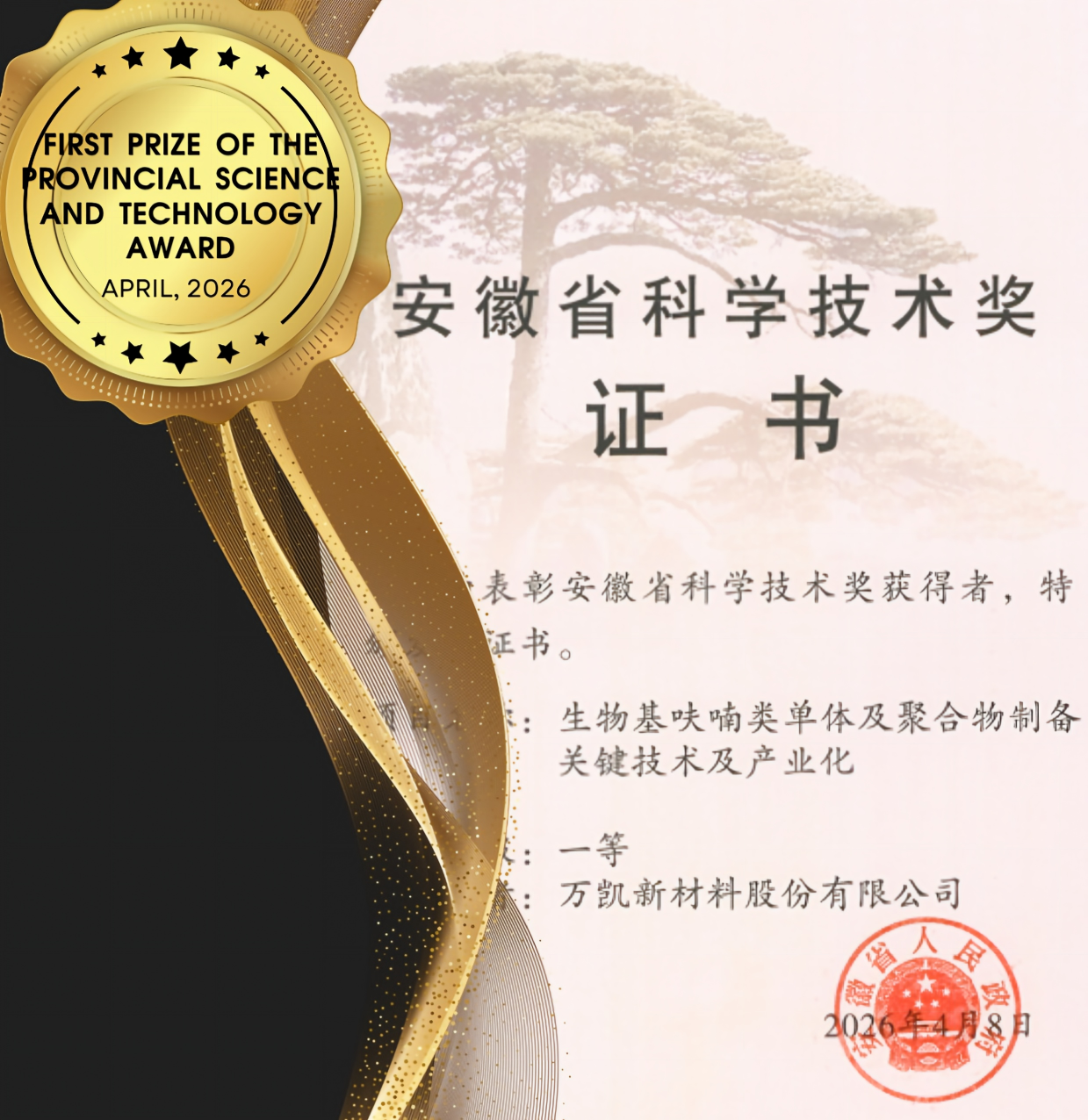
Wankai New Materials' Bio-based PEF Project Wins Provincial Science and Technology Award, Advancing Green Polyester Innovation
The award recognizes the project's achievements in the research, development, and industrialization exploration of bio-based polymer materials, marking another important milestone in Wankai's innovation journey in the polyester field.
As a global supplier of bottle-grade PET resin, Wankai New Materials has been deeply engaged in polyester materials for years. While continuously enhancing its capabilities in PET resin development, manufacturing, and application, the company is also actively exploring next-generation sustainable polyester technologies and new possibilities for the future of the polyester industry.
From Laboratory Research to Industrialization: Wankai Advances PEF Development
The development of bio-based furan polyester (PEF) involves multiple stages, including material research, polymerization process optimization, scale-up production, application evaluation, and industrial collaboration.
Wankai New Materials has been advancing PEF-related research and industrial exploration through continuous technological cooperation:
2023
Wankai's wholly-owned subsidiary, Kaipuqi, signed a strategic cooperation agreement with upstream raw material partners to jointly advance PEF-related industrialization efforts.
2024
Wankai completed ton-scale PEF industrial trial production, representing an important step in validating production processes and supporting further technology development.
2025
The company signed a technology cooperation agreement with Zhejiang University Innovation Center and jointly established a provincial key laboratory for bio-based polymer materials with Ningbo Institute of Materials Technology & Engineering, Chinese Academy of Sciences, strengthening collaboration among industry, universities, and research institutions.
2025
The PEF project obtained approval for food-contact applications in China, creating conditions for future application research and product development.
Through continuous innovation and collaboration, Wankai is promoting the transition of bio-based polyester technologies from laboratory research toward practical application scenarios.
What Is Bio-based PEF?
Polyethylene Furanoate (PEF) is an emerging polyester material based on FDCA (2,5-furandicarboxylic acid). FDCA can be produced from renewable biomass resources, making PEF an important research direction in the development of bio-based polymers.
Compared with conventional PET (Polyethylene Terephthalate), PEF demonstrates potential advantages in several barrier properties:
Higher oxygen barrier performance
PEF can provide approximately 10 times higher oxygen barrier performance than PET, helping reduce oxygen transmission through packaging materials.
Improved carbon dioxide barrier performance
PEF can provide approximately 6–10 times higher CO₂ barrier performance than PET, making it a potential candidate for applications requiring enhanced gas retention performance.
Enhanced water vapor barrier performance
PEF demonstrates approximately 2 times higher water vapor barrier performance than PET, offering potential advantages in selected high-barrier packaging applications.
PET and PEF: Complementary Polyester Solutions
While PEF shows potential advantages in certain high-barrier applications, PET remains one of the most widely used packaging polymers globally due to its mature industrial ecosystem, reliable processing performance, excellent mechanical properties, and cost competitiveness.
Wankai's bottle-grade PET resin products are widely used in:
- Beverage packaging
- Food and edible oil packaging
- Pharmaceutical packaging
- Other packaging applications requiring consistent quality and performance
The development of new polyester materials does not represent a replacement of PET, but rather provides additional material options for different application requirements.
Exploring the Future of Polyester Materials
From established bottle-grade PET resin solutions to emerging bio-based polyester technologies, Wankai New Materials continues to explore innovation pathways in the polyester industry.
By strengthening technological research, industrial collaboration, and material development, Wankai aims to provide customers with reliable and diversified polyester solutions while supporting the ongoing development of more sustainable packaging materials.